Reservations11 min read
Prepaid Restaurant Reservations: Selling Packages and Add-ons with the Booking
A package or an add-on is paid for specific content of the visit. Don't confuse it with a deposit, a service fee or a price per guest.
For owners and operations managers who want to sell menus, celebrations or services prepared in advance together with the booking.
A prepaid reservation means the guest pays in advance, when booking, for specific content of the visit: a tasting or holiday menu, a birthday package with a cake, or an add-on the restaurant has to prepare beforehand. It is not a deposit, whose main purpose is to cover the risk of a no-show, but the sale of something the guest will receive. It pays off where ingredients are bought or prepared in advance, kitchen capacity is limited and guests want to know exactly what awaits them. This guide is for owners and operations managers thinking about selling packages with bookings. It explains the terms, shows what you can sell, how to describe a package so it doesn't lead to disputes, what to settle for payment and cancellation, and what has to happen in the kitchen and on the shift.
Package, deposit, fee and price per guest
These four terms are often mixed up, yet each works differently and guests understand each one differently too. The table shows how they are typically used; the actual rules are always the terms the restaurant communicates to the guest in advance.
What the guest pays for and why
| Term | What the guest pays for | What typically happens to the payment | When it is used |
|---|---|---|---|
| Prepaid reservation (package) | Predefined content of the visit: a menu, a celebration, an experience | The guest receives the agreed service for it | Tasting menus, holiday menus, celebrations |
| Add-on | An extra to a regular booking: a cake, decorations, a bottle of wine on the table | Prepared for the visit and charged as a separate item | Birthdays, anniversaries, company dinners |
| Deposit | Part of the future bill, as security that the guest will come | Deducted from the bill on the visit; what happens after a no-show must be stated in the terms | Busy evenings, larger groups |
| Service or booking fee | The service itself, such as reserving a private room | The terms decide whether it counts towards the bill | Private rooms, a closed-off part of the dining room |
Price per guest and price per table are not further types of payment but ways of calculating one. Both a package and a deposit can be set per person or for the whole booking. Choosing between them deserves a separate article, as do deposits against no-shows and cancellation policies; this guide sticks to packages and add-ons.
What you can sell with a booking
A good candidate for a prepaid reservation is anything the restaurant has to prepare in advance and couldn't offer reliably without knowing the demand beforehand.
- Set menus: a tasting menu, brunch, a holiday or Valentine's menu, a company menu for a group.
- Celebrations: a cake, a welcome toast, table decorations, flowers.
- An experience at the table: a chef's table by the kitchen, wine pairing, a tasting.
- Space: a private room or a closed-off part of the dining room for a private party or a company dinner.
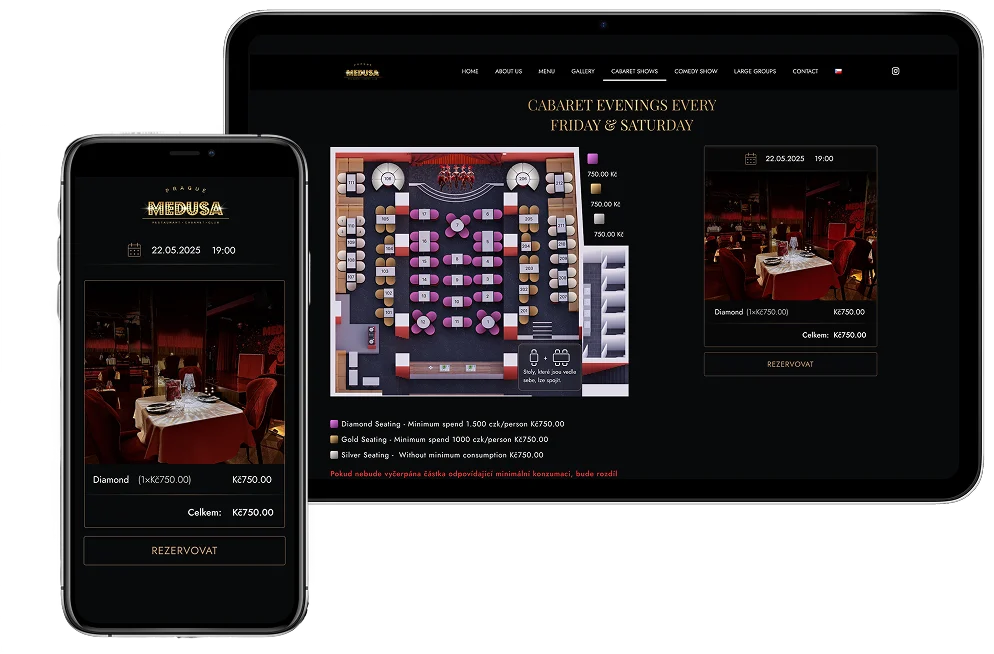
The line runs where a table booking turns into an event with a programme and a shared start. A tasting evening for the whole room, a cabaret or a concert is a different model: you sell a place at a specific event, not a table with an extra, which is the territory of event ticketing. The distinction has a practical impact: for an event you manage the capacity of the whole event and admission; for a package, kitchen capacity and a specific table.
When to ask for payment upfront and when not to
Upfront payment has a cost. Every extra step can put some guests off booking, and if guests don't understand why they should pay, the payment looks like distrust. So require it where it protects a real cost or gives the guest certainty, not across the board for every booking.
Which model to choose for which situation
| Situation | Suitable model | Why |
|---|---|---|
| A regular weekday dinner | Booking without payment | Payment would slow the guest down and protects no specific cost |
| Friday nights with repeated no-shows | A deposit, or reminders and easy cancellation | The aim is certainty that guests come, not selling content |
| A tasting menu with ingredients bought in advance | Prepaid reservation with the menu | The restaurant carries the cost before the guest arrives |
| A birthday with a cake | Booking plus a paid add-on | The cake is ordered in advance and only fits this visit |
| A private room for a company dinner | A room fee, menu by arrangement | The guest pays for reserving the space; food is handled separately |
| New Year's Eve or an evening with a programme | Ticket sales or a prepaid event | Fixed capacity and a shared start |
The models can be combined, but every combination raises the bar for clarity. A guest who pays both a deposit and a package must see in the confirmation what is what, and what happens to each amount if they change or cancel.
How to build a package that doesn't lead to disputes
With a prepaid reservation it pays more than anywhere else to describe exactly what the guest is buying. The package description should answer in advance the questions the guest would otherwise ask at the table:
- Name and content: what exactly the guest gets, how many courses, which drinks.
- What isn't included: drinks beyond the package, additional orders, any service charge.
- Price basis: per person or per table, and for how many people.
- Availability: days, times and how many packages the kitchen can handle per evening.
- Ordering deadline: how far in advance the package must be bought, for example because of a cake or special ingredients.
- Allergies and alternatives: how the guest reports restrictions and what the kitchen can substitute.
- Changes and cancellation: until when the date or party size can change, and what happens to the payment.
- Fewer guests: what applies when three people come instead of four.
Also check that the package description on the website, in the booking confirmation and in what the team on shift sees is the same. If the website promises a welcome toast and the kitchen doesn't know about it, the guest will be the first to notice.
Payment, confirmation and cancellation terms
With a prepaid reservation the order of steps decides. The guest picks a date and a package, the system holds the seat and the package capacity for the duration of the payment, and the booking is confirmed only once the payment has actually gone through. If the payment fails or the guest abandons it, the seat is released after the time limit. A restaurant that confirms bookings before it knows about the payment builds a list of bookings it can't be sure are paid.
Card payments are processed by a payment gateway. The restaurant shouldn't accept card numbers by e-mail, by phone or in the booking notes. What the team on shift needs is just the payment status: paid, unpaid, refunded. The payment status is not the same as the booking status; a confirmed booking can have a refunded payment, and a paid booking can be cancelled.
Set cancellation and refund terms in advance and show them to the guest before payment. Consumer law may give guests a right to cancel contracts concluded online, with exceptions that matter to restaurants. Two examples: in the EU, the Consumer Rights Directive gives consumers 14 days to withdraw from a distance contract (Article 9), but excludes catering and leisure services when the contract provides for a specific date or period of performance (Article 16, point l); each member state implements it in national law. In the UK, the Consumer Contracts Regulations 2013 set a 14-day cancellation period for service contracts (regulation 30) and exclude catering and leisure services with a specific date in the same way (regulation 28). Rules differ by country, so whether such an exception covers your particular package, for example one without a fixed date, is a question for a lawyer where you operate. Likewise, ask your accountant or tax advisor how to record and tax payments taken in advance.
What the kitchen and the shift need to know
A prepaid reservation behaves differently on the floor from a regular one. The kitchen needs to know in good time how many packages to prepare and in which variants. Front-of-house staff need to see what the guest has already paid, so they don't charge it again.
- A prep list for the day. Numbers of packages, variants for allergies, ordered cakes and their inscriptions.
- Payment status on the booking. Paid, unpaid, refunded, right on the booking rather than in another system.
- The bill at the end of the visit. The prepaid package must show on the bill as settled; anything extra is charged as usual.
- Changes on the spot. Who may swap or extend a package and how it shows on the bill.
- No-shows. What happens to the prepared courses and to the payment, according to the terms published in advance.
A no-show on a prepaid booking hurts less than on an unpaid one, but it doesn't disappear: the prepared ingredients and the empty seat remain. Reducing no-shows through communication, reminders and easy cancellation is a topic of its own.
What RestoCraft can do today
The RestoCraft booking system today covers online booking with available times, a temporary table hold while the booking is being completed, booking management by the guest (viewing, cancelling and changing the date and time), confirmations based on the booking status and the restaurant's settings (automatic reminders before the visit are still on the roadmap), and an operations overview where the team on shift sees the status, the table and the visit requests. Setup happens with the RestoCraft team.
Booking payments are not finished yet. Payment linked to a booking, meaning deposits against no-shows, is in early access and depends on a separate payments module, which is also in early access. Full prepayment and the behaviour of specific payment providers have not been verified yet. Packages, add-ons and gifts directly in the booking journey exist only as a product concept, not as a finished feature. If you want to sell packages now, handle their offer and payment separately, and make sure the information about the agreed package sits on the booking the team on shift sees.
Frequently asked questions
No. A deposit is mainly there to make sure the guest comes; it is usually deducted from the bill on the visit, and what happens to it after a no-show must be set in the terms in advance. A prepaid reservation sells specific content of the visit: a menu, a celebration, a service. The two can be combined, but the guest must know what they are paying for and why.
Usually not. For a regular dinner, upfront payment adds a step that slows the guest down and protects the restaurant from no specific cost. It pays off where you buy, prepare or reserve limited capacity in advance.
That depends on the lead time the kitchen needs. For a cake or special ingredients, set a fixed deadline for ordering the add-on. After it passes, offer it only after checking with the kitchen.
Key takeaways
A prepaid reservation sells the content of the visit; a deposit sells certainty that the guest will come.
Price per guest or per table is a way of calculating, not a type of payment.
A package needs exact content, capacity, an ordering deadline and terms for changes.
A booking with payment is confirmed only once the payment is complete.
Publish cancellation terms before payment and have a lawyer in your country review them.
In RestoCraft, booking payments are in early access and packages are still a concept.
Conclusion
Prepaid reservations make sense where the restaurant sells something it has to prepare in advance, and the guest is happy to pay because they know what they'll get. Start with one clearly described package for dates where demand is certain, check your cancellation terms with a lawyer, and expand the offer only once the kitchen and the shift handle the package without trouble. Before you set the price, decide whether you'll calculate it per guest or per table. And if your main problem is no-shows rather than selling content, start with a deposit or better communication with guests instead.