Reviews and reputation11 min read
Guest Recovery: Handling Negative Feedback Before It Becomes a Public Review
Guest recovery is an agreed procedure for when a guest isn't happy: take ownership, get in touch, resolve, record and learn.
It isn't about preventing a public review. Every guest gets the same invitation to review you on Google.
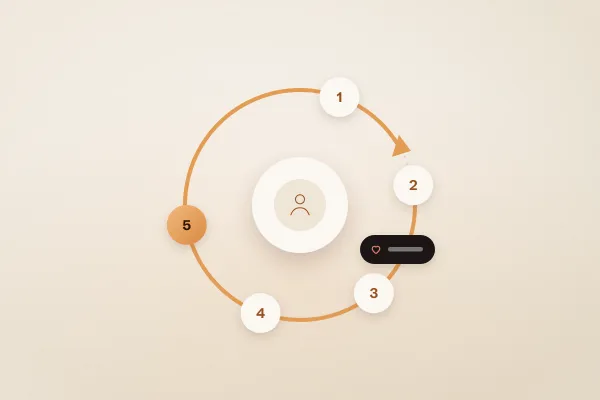
Guest recovery is an agreed procedure for the moment a guest isn't happy: someone takes ownership of the feedback, gets in touch, fixes the problem, records the outcome, and the team learns from it. It works best when the restaurant hears about the problem during the visit or shortly after, through its own feedback form at the table or on the website, before a public review is the only trace left. The aim is not to prevent public reviews: every guest gets the same invitation to rate you on Google, and handling a complaint has nothing to do with it. This guide is for owners and managers of restaurants, cafés and bistros. It shows when to open a guest case, who owns it, how to contact the guest, how to decide on compensation and how to turn individual complaints into changes on the floor.
What guest recovery is and what it isn't
A reply under a review is a public reaction to something that has already happened, read by strangers. Guest recovery is private work with a specific guest and a specific problem: it has an owner, a deadline, a next step and an outcome. The two can meet (a guest whose problem you solved may still write a critical review, and you reply factually), but they are not the same thing.
An apology on the spot, a guest case and a public reply
| Criterion | Apology on the spot | Guest case | Public reply |
|---|---|---|---|
| When | During the visit | After internal feedback or a complaint | After a review is published |
| Who sees it | The guest at the table | The guest and the restaurant team | Anyone on Google |
| What it allows | Fixing things at once, replacing a dish, explaining a delay | Investigating, getting in touch, deciding on a solution, recording the outcome | Showing future guests how the restaurant responds |
| Weak spot | Leaves no record and nobody else learns from it | Without an owner and a deadline it gets lost | The guest's problem often can't be solved any more |
| Who is responsible | Floor staff, the shift manager | A designated manager | The owner or a manager |
The first two together are strongest: the apology on the spot softens the problem and the case makes sure it isn't forgotten. Guest recovery, on the other hand, is not:
- deleting or hiding criticism: internal feedback isn't rewritten, and the restaurant can't remove a public review on its own;
- a filter in front of Google: an unhappy guest must not lose the invitation to leave a Google review that other guests get;
- a trade: compensation is never conditional on the guest not writing, changing or deleting a review.
How first-party feedback differs from Google reviews, and how to ask for both fairly, deserves a separate article.
When feedback becomes a case
First, you need to hear about the problem. The shortest route is the code the guest is already using at the table: when one QR code covers the menu, waiter call, reviews and the loyalty account, guests don't have to look for a feedback form elsewhere. Not every critical remark needs its own case, though. In practice, a combination of two rules works well.
A rating threshold. The restaurant decides from how many stars down feedback counts as critical, for example two or fewer, or three or fewer. A lower threshold means fewer cases and more time for each; a higher one also catches guests who were ‘only’ disappointed.
Signals in the text regardless of the stars. Some topics always open a case: an allergen or health problems, a foreign object in food, hygiene, an injury, a conflict with staff, an incorrectly charged amount. A guest can give three stars and still describe something the head chef must deal with that same day.
With serious reports, such as suspected illness after a meal, don't stop at a record in the system. Inform the owner and follow your venue's own food safety and incident procedures.
Who owns the case, and by when
A case without an owner is just another comment. Decide in advance:
- who takes cases during opening hours (usually the shift manager) and who outside them;
- who handles kitchen topics, who service and who payments;
- how quickly the guest should get a first response: an internal target, for example by the end of the day for ordinary complaints and immediately for serious ones;
- who may decide on compensation, and up to what amount;
- when a case counts as resolved and who closes it.
Also distinguish the states of a case: waiting to be picked up, in progress, waiting for the guest, resolved. ‘Waiting for the guest’ matters: the restaurant has taken its step, so the case shouldn't flash as unhandled, but it mustn't get lost either. When the guest gets back in touch or the problem returns, reopen the case instead of creating a new one, so the whole history stays together.
Contacting the guest: voluntary and only to resolve the issue
A guest who gave a low rating often doesn't want a long correspondence. They want to know someone listened. So the guest should decide about contact: offer the option to leave an e-mail address or phone number, but don't require it. The first message should be short and specific:
- thank them for the feedback and restate what, in their view, happened;
- apologise for what the restaurant is genuinely responsible for, without blaming colleagues or suppliers;
- say what you have already checked or changed;
- offer a solution, or ask what would help;
- don't ask them to change anything on Google.
Use contact details the guest left to resolve a complaint for that purpose only. Under the GDPR, personal data are collected for specified, explicit and legitimate purposes and not further processed in a way incompatible with them (Article 5, paragraph 1(b)), and consent is given for specific purposes (Article 6, paragraph 1(a)). Adding a guest to your newsletter after a resolved complaint is therefore not automatic. How to inform guests about the processing and on which legal basis to use the contact is a question for your data protection advisor; outside the EU, check your local rules.
Resolution and compensation with no strings attached to reviews
Compensation isn't a mandatory part of every case. Sometimes an explanation and a change on the floor are enough; at other times a partial refund, a new dish, an invitation for another visit or a coupon is appropriate. A simple guideline helps: compensation matches what the guest actually lost (time, food, the experience), and only someone with the authority decides how much. What was offered and accepted goes into the case record.
One rule applies without exception: the resolution must not depend on a review. Google's policy for user content on Maps prohibits offering incentives such as payment, discounts or free goods or services in exchange for posting a review or for revising or removing a negative one (Prohibited and restricted content, Google). A line like ‘we'll send you a voucher if you take the review down’ has no place in any message.
From individual cases to changes on the floor
One case fixes things for one guest. Ten similar cases point to a problem in how the restaurant runs. So once a week, go through closed cases and sort them by topic, for example staff, food quality, price and value, atmosphere, speed of service and cleanliness.
For every recurring topic, three questions are enough: what is the cause, who will remove it and how will we know things have improved? Share the result with the team at a briefing; staff who see that complaints led to change take guest recovery more seriously. In the long run, working with unhappy guests is part of the wider effort to bring guests back again and again.
How RestoCraft ReviewHub supports guest recovery
RestoCraft ReviewHub collects guest ratings from the Premium QR menu, from RestoCraft Sites websites and through a widget on your own website: the guest gives 1 to 5 stars and can add a comment and, optionally, a name and e-mail address. The rating goes to the restaurant to check and is never published automatically. These parts matter for guest recovery:
- Guest case. An optional rule, switched off by default, opens a case linked to the review when a rating is at or below the chosen threshold (1–5, default 2).
- Case workspace. Queues, states, team notes, a next step with date and time, a reply to the guest by e-mail, history, resolution and reopening. The reply is queued for sending; delivery is not confirmed yet.
- Reply deadline. Reviews with 1–3 stars get the status ‘reply soon’ („Odpovědět brzy“ in the Czech admin) after two hours and are overdue after 24 hours.
- Contact at the guest's request. In Premium QR, after a 1–3 star rating that opened a case, the guest can ask to be contacted: name, e-mail or phone, plus an explicit confirmation. The request is stored with the case; it creates no CRM profile and no marketing consent.
- A person approves every reply. Nothing is sent or published automatically. AI reply suggestions and AI topic analysis are in early access and switched off by default.
- How it was resolved. A compensation record for the case (credit, refund, coupon) can so far only be saved through the API, with the interface in development; it is a record, not an actual refund. A coupon or points in RestoCraft Loyalty are issued manually by a manager.
After a rating is submitted, the RestoCraft widget offers a link to a Google review to every guest regardless of the number of stars, so an open case doesn't replace the Google review invitation.
Rollout checklist
- Set the rating threshold and the list of topics that always open a case.
- Name the owner of cases during and outside opening hours, and their stand-in.
- Set an internal target for the first response to ordinary and serious cases.
- Write down who may decide on compensation and up to what amount.
- Prepare a short template for the first message that the manager always adapts.
- Check that every guest gets the same Google review invitation and that a case doesn't hide it.
- Make sure contact details from a case aren't used for marketing.
- Once a week, go through closed cases by topic and pick one change for the floor.
Frequently asked questions
A case isn't meant to talk the guest out of a review. They should get the Google review invitation just like everyone else, and if they write a review, that is their right. Reply to a critical review factually, without details from the internal case and without arguing over specifics.
Never make the resolution conditional on updating or deleting a review, and offer nothing for it; Google's policy prohibits such incentives. If the guest updates the review on their own, that is their decision.
Whoever is closest to the problem should take the case, usually the shift manager, who knows about it while service is still running. The owner or general manager should see all cases, decide on larger compensation and review recurring topics once a week.
Then close the case with a change on the floor rather than a message. Record what you checked and what you changed. If the guest publishes a review, you can say the same briefly in your public reply.
Key takeaways
Guest recovery is a procedure with an owner, a deadline and an outcome, not just a reply under a review.
A case is opened by the rating threshold or by a serious signal in the text, whatever the stars.
The guest decides about contact; their details serve only to resolve the complaint.
Compensation never depends on what the guest writes, changes or deletes on Google.
Every guest gets the same invitation to leave a Google review.
Recurring topics from cases are the basis for changes on the floor.
Conclusion
Guest recovery rests on a simple idea: an unhappy guest is information the restaurant got before anyone else. When every piece of critical feedback has an owner, a deadline, a fair resolution and a record, the team stops defending itself and starts fixing things. Start with a rating threshold and one responsible person, then add a first-message template and a weekly review. A tool makes the work easier, but the rules have to be yours.